



OEM/ODM PPF Partnerships: From Concept to Custom Brand
Launching a private-label PPF brand starts with OEM/ODM partnerships, where OEM and ODM differ. OEM builds to buyer specs; ODM adapts proven designs. The OEM/ODM scope shapes PPF quality, cost, and compliance for an OEM/ODM PPF line. What does the journey from concept to market-ready PPF look like? Model choice, partner vetting, customization, quality control, cost, and compliance follow.
Key Takeaways
Pick ODM if you want a faster, cheaper start with smaller orders. Pick OEM if you want full customization and exclusivity.
Check your manufacturing partner closely: look at factory certifications, ask for samples, and make sure each batch is the same.
Plan your budget beyond just the unit price. Include tooling, freight, duties, and MOQs so you don't get surprised.
OEM vs. ODM: China PPF Models
The china ppf oem vs odm choice shapes every later step of a private-label launch. OEM means making film to the buyer's specifications. ODM means adapting a manufacturer's proven designs under the buyer's brand. Both paths produce a branded PPF roll. They differ in who does the technical work.
OEM Model
OEM usually starts with a brief the buyer defines. The buyer supplies a detailed specification they own, covering film thickness, adhesive optimization, top-coat options, and special performance targets. Color and finish requests, custom packaging, printed cartons, and technical documents also belong to this brief. The factory then builds to that document.
This model suits established distributors with clear technical requirements and steady volume. The buyer owns the film specification and controls future changes. A buyer-owned specification also supports exclusivity talks, because the product exists for that buyer alone.
Your Specification. Our Manufacturing. Your Exclusive Product.
If you already own a detailed PPF specification — covering thickness, adhesive optimization, top-coat performance, custom colors, and branded packaging — KOOPPF's OEM program is built to execute it precisely.
Whether you're launching a private-label line, optimizing an existing SKU, or negotiating exclusivity for your market, our team can review your brief and confirm feasibility, MOQ, and lead time.
Submit Your OEM Specification →ODM Model
ODM usually brings product development led by the supplier. The manufacturer contributes an existing design or develops a solution around the buyer's goals. The buyer still approves the result, yet the supplier carries more of the technical design work. That structure lowers the decision burden for a first-time brand owner.
A clearly identified existing film can be a manageable starting point when technical resources and demand are limited. Limiting the first range also helps a new team separate product issues from training or storage problems. Many brands begin with ODM and move to OEM as volume grows.
The table below sums up the oem vs odm decision across key dimensions.
Dimension | OEM | ODM |
|---|---|---|
Brand involvement | Buyer-centered presentation on a proven system | Deeper role in product definition |
Customization scope | Logos, packaging, labels, model planning | Color systems, new effects, structure, thickness, performance |
R&D responsibility | None for the brand | Joint development with the supplier |
Primary purpose | Fast, asset-light market entry | Product exclusivity and protected margin |
Best suited for | Importers and film chains with distribution | Brands building technical barriers |
One caution applies to both oem and odm arrangements. Suppliers sometimes label private-label orders as OEM. The real difference is whether the buyer buys an existing film under their brand or a product made to their technical specification. Exclusivity is never implied under ODM. It must be agreed explicitly by product, territory, channel, duration, and purchase conditions. The partnership model and the film choice should grow together, with documented responsibilities counting more than the commercial label.
China PPF OEM vs. ODM in a Real Order
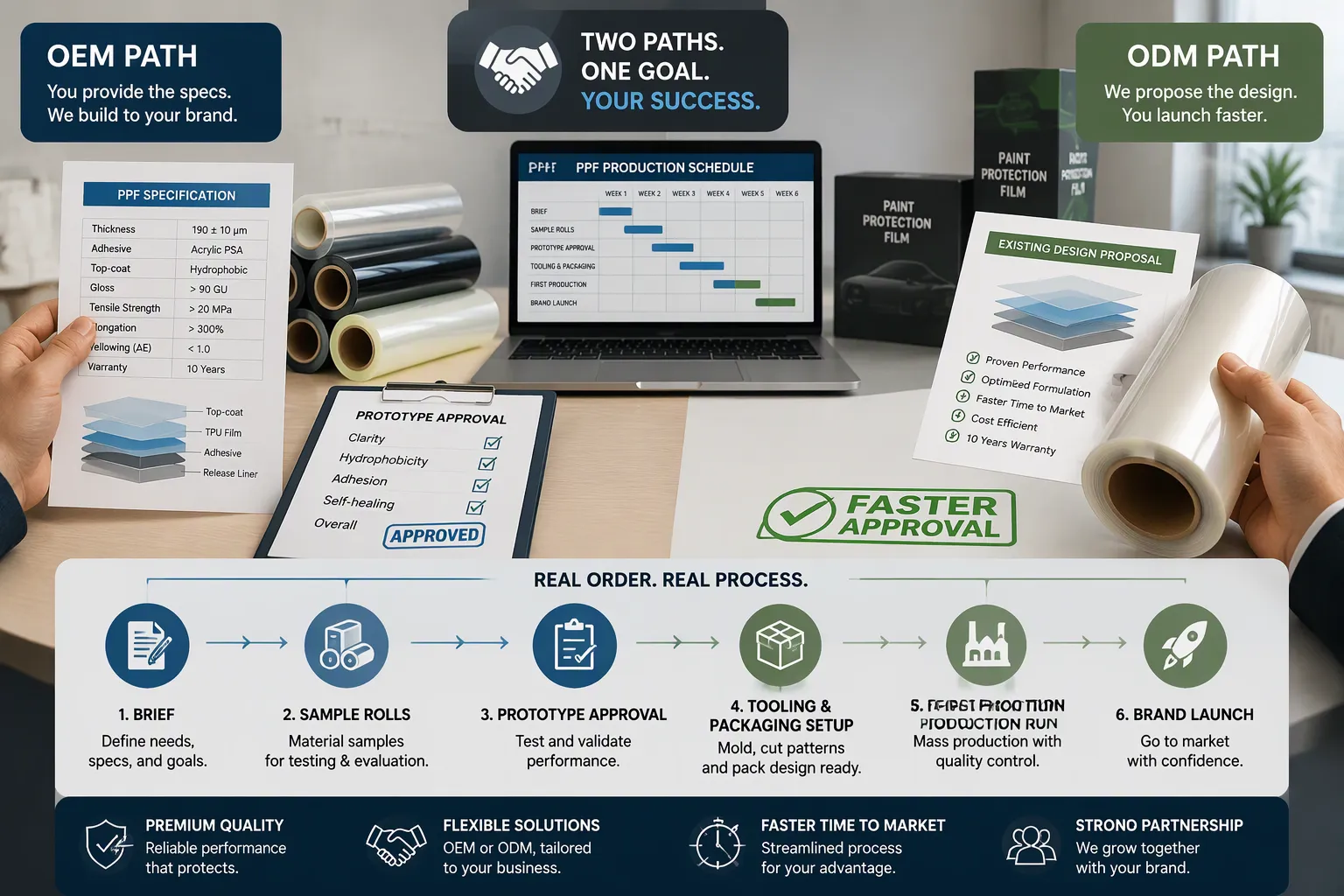
A real order shows how the china ppf oem vs odm decision works in practice. The steps follow a clear path: brief, sample rolls, prototype approval, tooling and packaging setup, first production run, then brand launch. Each stage is different on the two paths, and the china ppf oem vs odm in a real order contrast shows up at every handoff.
Concept to Prototype
The process starts with a fit check. The buyer defines the target market, channel, country or region, and launch goals. This scoping stage takes 1–3 business days. An oem/odm ppf partner then confirms feasibility and points out any spec gaps. A clear brief prevents rework later. The buyer should map each step onto their own launch plan before committing.
Here the paths split. OEM usually starts with a buyer-defined brief, and the buyer supplies a buyer-owned specification covering thickness, adhesive, and top-coat targets. ODM usually brings supplier-led product development, where the manufacturer proposes an existing design or develops one around the buyer's goals. The supplier carries more design work under ODM, and the buyer carries more under OEM.
Sample rolls come next. Formulation and sampling take 2–3 weeks. The buyer tests ppf rolls for thickness, gloss, elongation, and adhesion before approval. A scoped oem or odm project then moves to prototype approval. OEM approval steps are stricter because the buyer owns the spec and signs off on every parameter. ODM approval is faster because the supplier already validated the base design. The buyer still approves the final sample, yet fewer review cycles are needed.
Production to Launch
Packaging design follows, taking 1–2 weeks. Label and spec alignment runs about 1–2 weeks. The launch sequence then proceeds in order:
Brand vision and product selection lock the range.
Custom formulation and packaging design finalize the SKUs.
Sample approval confirms the final rolls.
Production and QC run the batch.
Shipping and launch deliver the goods.
Production takes 3–4 weeks with strict quality control. Shipping adds 25–40 days, and total door-to-door time lands around 8–12 weeks. A first order benefits from a written checklist that tracks each approval. The buyer should confirm lead times in writing.
MOQs differ too. An oem or odm project with a custom oem proposal often carries a higher MOQ on the OEM side, because tooling and packaging serve one buyer. ODM orders can start smaller. The china ppf oem vs odm in a real order contrast is clearest here: OEM trades flexibility for exclusivity, and ODM trades exclusivity for speed.
The final step is brand launch. The buyer receives the ppf shipment and releases the line. A well-run oem/odm partnership keeps every approval documented. The china ppf oem vs odm in a real order sequence then becomes a repeatable launch template. Both oem and odm paths reach the same goal, and both oem and odm reward careful planning.
Choosing an OEM/ODM PPF Partner
A strong oem/odm ppf partner decides whether a private-label launch works. Buyers should check candidates against clear rules and look for warning signs during due diligence.
Vetting Criteria
Begin with manufacturing depth. A fully integrated oem/odm manufacturer controls the whole chain, from TPU base film casting to precision coating. Look for in-house TPU casting, verified dust-free cutting and production lines, and multi-layer co-extrusion technology. That depth supports steady batch consistency and dependable lead times.
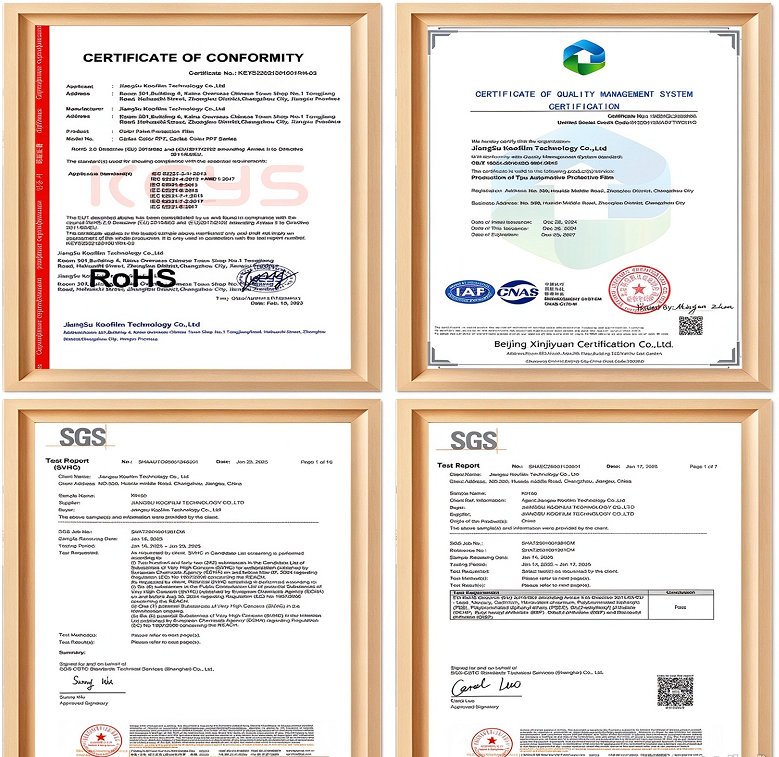
Next, check quality systems and material authenticity. Ask for samples so you can test adhesive strength, UV resistance, conformability, and removability on your own. Confirm certifications such as ISO 9001, CE, RoHS, and REACH, plus independent lab reports. A factory audit should cover raw material traceability, color checks with a spectrophotometer, coating line cleanliness, and equipment calibration records. Strong oem/odm capabilities also include quick after-sales support and written QC protocols.
KOOPPF meets these standards with a 50,798 m² factory, 13 production lines, and 80,000+ rolls monthly capacity at 7–15 day lead times. Certifications include ISO 9001, IATF 16949, and REACH. TPU comes from Lubrizol/BASF; adhesive from Ashland. Free samples and factory audits are available. We offer full OEM/ODM customization and same-day support.
Contact KOOPPF for samples or to schedule a factory review.
Red Flags
Due diligence should catch several behaviors. A supplier that refuses or dodges requests for material certifications and independent lab test results is a concern. Missing material traceability documents is another warning sign. Buyers should also confirm the partner is a real factory, not a trading company or white-label reseller. This difference affects quality control, batch consistency, and production lead times.
Batch samples that don't match, unclear raw-material sourcing, and slow technical support deserve a closer look too. Treat these as checkpoints, not accusations. A careful oem/odm collaboration depends on verified facts, so buyers should write down every claim before signing.
Customizing Products and Building Your Color PPF Brand
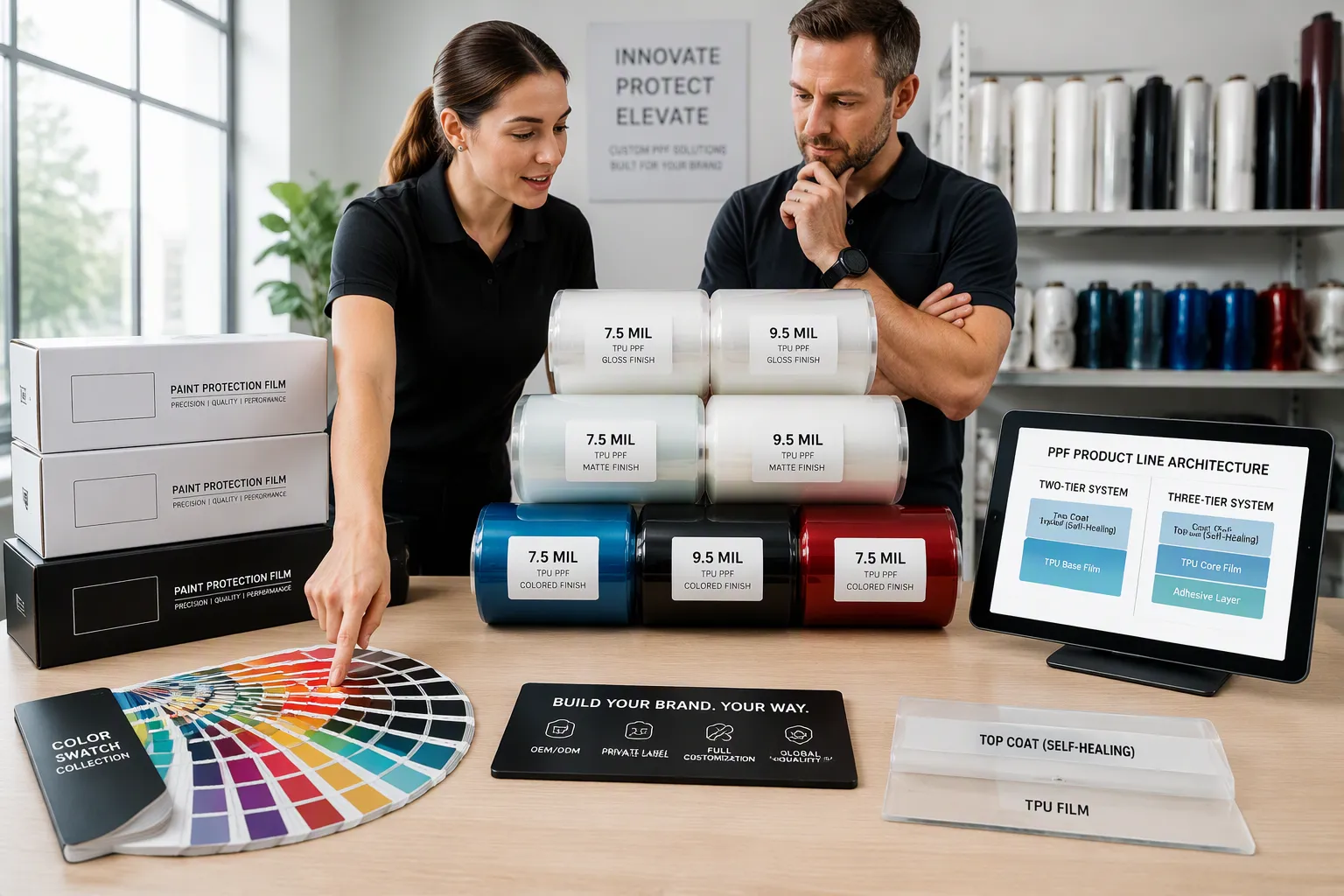
Customization is what turns a film line into a brand. Buyers control several levers: clear, matte, and colored ppf tiers, thickness options, adhesive and top-coat choices, plus private-label packaging and brand identity. A mature colored ppf product system gives a new brand room to grow without rebuilding the supply chain.
Customization turns film into a brand. KOOPPF gives buyers control across clear, matte, and 200+ color PPF tiers, with 7.5–8.0mil thickness options, adhesive and top-coat choices, plus private-label packaging and brand identity support. KOOPPF lets new brands grow without rebuilding their supply chain—from first sample to full private-label program.
Product Tiers and Formulations
A sensible structure starts small. Launching with many SKUs creates MOQ complexity, because each SKU needs its own minimum production commitment. Most brands begin with two or three SKUs and expand after proving demand.
Product Line Architecture | Structure | Positioning |
|---|---|---|
Two-tier | Entry + Premium | Entry at 6.5–7 mil for value; Premium at 8–8.5 mil for performance |
Three-tier | Entry + Performance + Signature | Signature carries maximum spec and reaches three buyer segments |
Finish-focused | Gloss + Matte as separate lines | Same core film, different top coat finish |
Formulation choices matter just as much. Private label puts a brand on an existing product and reaches the market fastest at lower upfront cost. Color ppf oem work makes film to the buyer's specs and takes longer, yet the product becomes truly theirs. A practical plan starts with private label to test demand, then plans for color ppf oem once response is known.
Top-coat and base-material decisions drive performance. Buyers should ask who supplies the TPU and at what grade. Total thickness adds up the top coat, TPU base film, and adhesive layer, so thickness alone does not show quality.
Launching Your Own Color PPF Brand
Building an own color ppf brand follows a sequence. First, secure a manufacturer with full-chain production. Second, build a coherent color collection rather than an overloaded catalog. Third, develop region-specific shades. Fourth, engineer the top-coat technology. Fifth, run multi-stage quality control across material, coating, color, and weathering. Sixth, customize packaging, warranty cards, and roll identification. Seventh, produce branded sample books for installers. Eighth, keep production flexible for pilot orders. Ninth, prepare protective packaging for global shipping. Tenth, strengthen the installer network with cutting software and vehicle data.
Batch color consistency depends on control at five stages: TPU preparation, color formulation, film casting, multi-layer coating, and inspection. A color ppf brand that holds these stages steady delivers uniform color, thickness, and finish across batches. That reliability supports any oem/odm collaboration and protects the brand's reputation.
Clear ppf, matte lines such as the Shadow Walker series, and color ppf with 200+ shades and a 10-year warranty show how tiered ranges fit together. Strong oem/odm customization and a mature colored ppf product system let an own color ppf brand scale from first order to full catalog.
Quality Control and Testing
Quality control protects both the buyer and the manufacturer. A written testing plan turns a film specification into a standard you can check. Buyers should draft this plan before the first production run.
Pre-Production Samples
Sample approval confirms the film meets the agreed targets. Buyers test thickness, gloss, elongation, UV resistance, and adhesion before committing to a run. The table below shows typical acceptance values for clear ppf samples.
Property | Test Method | Representative Acceptance Value |
|---|---|---|
Total thickness (clear gloss) | Micrometer | 8.5 mil (±0.3) |
Total thickness (clear matte) | Micrometer | 7.5 mil (±0.3) |
60° Gloss | ASTM D523 | ~94 GU |
Tensile strength / Elongation | ASTM D882 | ~8200 PSI & ~450% |
Mechanical properties follow ASTM D882, and gloss follows ASTM D523. Adhesion of thick films is usually checked by peel strength. The ASTM D3359 cross-cut test works for thinner coatings but has limits on thick ppf films.
Ask for peel adhesion retention measured per ASTM D3330 after 72 hours at 85°C; a retention result below 80% means the adhesive is heat-sensitive and not good enough for warm climates.
Batch Consistency Protocol
Batch consistency is what separates a reliable supplier from an inconsistent one. Strong oem/odm capabilities depend on quality control, traceability, and steady raw material sourcing. Batch records link production settings to specific finished roll lots. Inline monitoring during coating uses optical sensors for top coat thickness, defect-detection cameras for surface inclusions, and tension monitoring for even winding.
Finished roll testing covers optical properties, mechanical properties, adhesion, and self-healing performance. UV accelerated aging runs regularly against the reference formulation. Slot-die coating keeps thickness uniformity at ±2% or better. Controlled UV curing gives a consistent cure depth. These steps keep colored ppf and color ppf rolls even across batches. Buyers should ask for batch records and test reports for every colored ppf order.
Cost Structure and Logistics
Breaking Down Costs
A first PPF order has several cost layers beyond the unit price. Buyers must plan for tooling and packaging setup, which covers custom cartons, labels, and any color-matching work. The MOQ directly affects unit economics. Stock clear and matte films usually start at 20 rolls, while OEM packaging or private-label custom orders need 100 rolls or more. Sample orders start at just one roll, so buyers can check quality before spending more money.
Freight and duties add a large expense. Sea freight from Shenzhen to the US West Coast costs $2,500–$3,500 per 20-ft container, which comes to roughly $5–$15 per roll depending on container utilization. Import duties can push landed cost 25–60% above FOB, varying by product classification and country-of-origin documentation. A sample roll shipped by air costs $350–$420 and is still the recommended first step. The landed cost formula is simple: (EXW + sea freight + insurance + import duties) ÷ roll count.
Cost Component | Estimated Cost | Notes |
|---|---|---|
Sea freight (Shenzhen → US West Coast) | $2,500–$3,500 per 20-ft container | Roughly $5–$15 per roll depending on container utilization |
Import duties | Landed cost 25–60% above FOB | Varies by product classification; confirm with a customs broker |
Sample roll (incl. air freight) | $350–$420 | Recommended before placing a volume order |
Landed cost formula | (EXW + sea freight + insurance + import duties) ÷ roll count | — |
Inventory and Shipping
Inventory planning starts with the MOQ decision. An oem/odm partnership usually requires 10–50 rolls for private label or custom colors because of coating, curing, and color-matching setups. Off-the-shelf films from distributors often carry an MOQ of just one roll. New brands should start with stock clear gloss or matte films, then move to OEM or private label once monthly volume justifies the larger commitment.
Lead times differ between the two paths. An oem usually starts with a buyer-defined brief, which makes the timeline longer because the buyer owns the specification and reviews every parameter. An odm usually brings supplier-led product development, which shortens the schedule since the manufacturer already validated the base design. Production runs take 3–4 weeks, with shipping adding 25–40 days door-to-door.
The value equation goes beyond unit price. Stability, technical support, and after-sales service are part of the real cost. A reliable oem/odm collaboration prevents costly batch failures and installation complaints. Buyers who factor service into their cost model make smarter sourcing decisions than those chasing the lowest per-roll figure alone.
Compliance and Market Readiness
Industry Standards
A private-label brand should check the standards behind its film spec before printing any claim. Ask the manufacturer for UV and weather testing data, like QUV accelerated aging results. Also ask for adhesion and elongation numbers measured by named methods. Confirm the international certifications that apply and keep the reports on file. The oem/odm partner should supply these documents for every model, not just the launch SKU.
The paperwork must match the product. Warranty card wording, installation notes, and performance claims should line up with the chosen model and its test method. A clear SKU or model code, roll label, and batch reference system lets customer service and repeat orders trace the product. This matters most for colored ppf lines, where color claims get extra attention.
Warranty and Support
Warranty structure needs a written plan before launch. A brand should settle four points early:
Define what the warranty covers and what it leaves out.
Decide who pays for replacement film versus labor.
Set up how film batches are traced for claims.
Back up claim talks with clear codes, photos or videos, and agreed handling rules.
Tiered coverage works well. Clear ppf models carry 7 to 10 years by model, and color ppf lines carry a 10-year warranty. Before production, line up the film tier, finish, thickness, topcoat target, roll label, box copy, warranty card, sample book, and dealer messaging.
Installer training protects the warranty. A structured program covers surface prep, adhesive control, squeegee technique, and edge sealing. Advanced colored ppf certification adds color handling, tension management, and finish preservation. Certification should rest on objective evaluation, not attendance. Demand for installer certification is rising, and brands that build academies earn loyalty.
The path goes from picking a model to checking partners, customizing, quality control, cost, and compliance. Each step builds on the one before it. A strong oem/odm ppf partner makes that path easier.
Research, a good manufacturer relationship, and steady quality move a custom brand forward. The oem/odm route pays off when you plan carefully. A color ppf brand can grow for years in this growing market.
FAQ
How does a first-time brand choose between OEM and ODM?
A first-time brand often starts with ODM. This path lowers the technical burden and allows smaller order volumes. Established distributors with clear specifications usually move to OEM for exclusivity.
How long does a private-label PPF launch take?
A typical launch runs about 8–12 weeks door-to-door. Production takes 3–4 weeks, and shipping adds 25–40 days. OEM timelines run longer because buyers approve every specification.
How can a buyer verify batch consistency before ordering?
Buyers should request batch records and test reports for each order. They can also compare sample rolls for thickness, gloss, and color. A spectrophotometer check confirms color accuracy across batches.



