



5 Things to Look for in a Long-Term PPF Supplier
A long-term PPF supplier is a partner you can plan around, not a roll you buy once. The global paint protection film market was valued at USD 527.5 million in 2025
Last updated: September 2026. Disclosure: This guide is published by KOOFILM, a paint protection film manufacturer. We write from the manufacturing side of the industry, so read it as an informed supplier perspective rather than a neutral third-party review, and verify key claims against your own samples and documents.
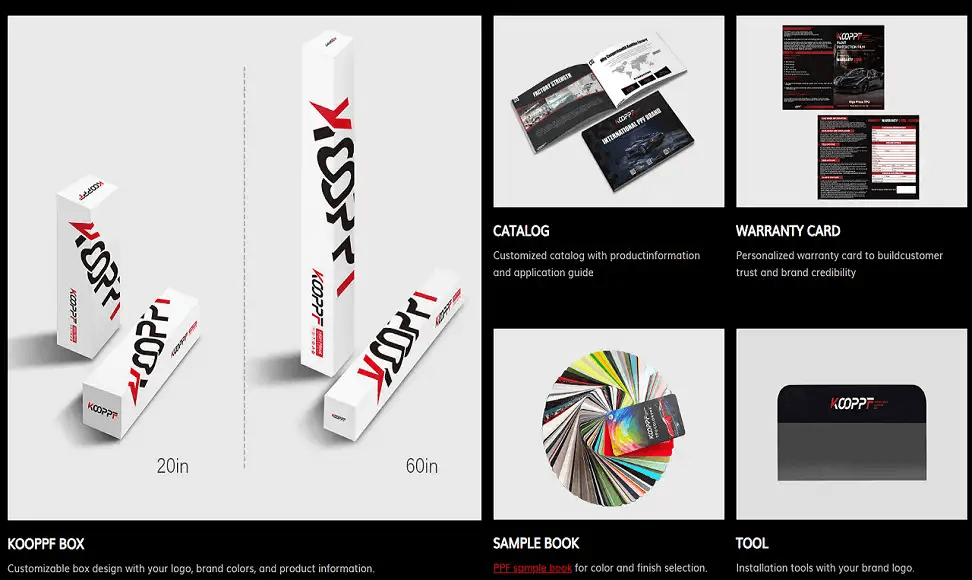
These are the five PPF supplier selection criteria we apply, in the order a distributor should apply them. Technical verifiability comes first, because material construction, batch-to-batch consistency, and verified performance documents decide whether the film performs at all. Supply reliability comes second, because a film that cannot be reordered in the same specification is a one-time sale. Commercial and after-sales terms come last, because margin and support only matter once the product and the supply behind it hold up.
KOOFILM brings that same structure to its own operation: a 50,000 m² facility, more than 300 employees, output above 80,000 rolls per month, and over 1,000 partners served.
KOOFILM is a fully integrated manufacturer of paint protection film, handling every stage from TPU casting to coating at its 50,000 m² facility with over 300 employees and output of more than 80,000 rolls per month. Because the company produces the film itself and supplies a global network of over 1,000 partners, this guide to evaluating long-term PPF suppliers draws on its direct experience of the manufacturing and supply side of the industry.
1. Material Construction You Can Verify on Paper — Best for Confirming What You Are Actually Buying
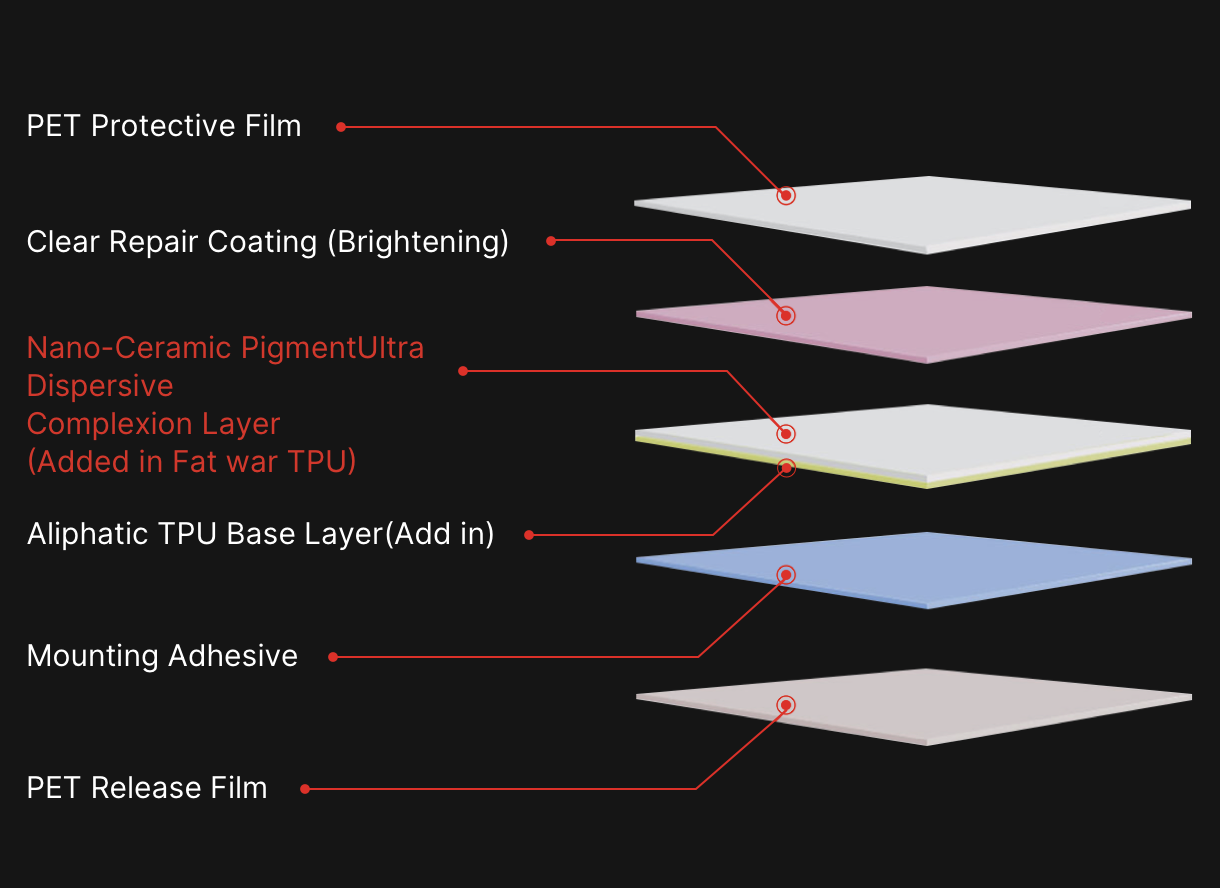
A technical data sheet, not a brochure, is the document that tells you what a film is actually made of. A usable TDS enumerates the layer stack, cap or release liner, top coat, TPU base and pressure-sensitive adhesive, with a thickness for each layer, and names the material grade, such as aliphatic TPU, instead of quoting only a total film thickness.
That distinction matters because each layer drives a different failure mode. The top coat governs stain and scratch resistance, the TPU base governs yellowing and impact absorption, and the adhesive governs whether removal damages paint.
So the question to put to any paint protection film supplier is narrow: send the TDS and confirm the per-layer thicknesses and the TPU grade. Compare the answer against the standard roll format of 1.52 m x 15 m, with custom sizes available, as your baseline spec.
One limit worth stating: acceptable thickness ranges and grade requirements vary by market and order volume, and a TDS is a framework for questioning a supplier, not a substitute for testing samples.
2. Batch-to-Batch Consistency and Lot Traceability — Best for Protecting Repeat Orders
The first order is not the test. The second one is. Batch-to-batch and roll-to-roll consistency spans thickness, clarity, gloss or texture, adhesive tack, liner release, stretchability and self-healing recovery, and drift in any of those properties signals weak process control. In the field it shows up as install inconsistency and warranty disputes, which is the reputation risk a distributor carries long after the invoice clears.
Make consistency part of your PPF supplier selection criteria rather than a hope. Four checks catch most drift before it reaches an installer: match lot and roll IDs against the invoice and packing list, photograph the box and core labels on arrival, review the supplier's batch test reports, and compare incoming rolls against a retained golden sample.
Reorder timing is where consistency risk and supply risk meet. Off-season lead time for standard clear and gloss PPF usually runs 10-20 days, peak season stretches to 20-30+ days, and Chinese New Year can disrupt production for three to four weeks. A supplier who cannot show lot traceability also cannot tell you which batch is late.
3. Verified Performance and Compliance Documents — Best for Defending Warranty Claims
A warranty is only as strong as the paperwork behind it. When a distributor asks a long-term PPF supplier to defend a claim on a defective roll, the supplier either produces documents or it does not.
The document set to request is specific: a full valid ISO 9001 certificate in the supplier's legal company name with issue and expiry dates, a REACH declaration or SVHC test report, a RoHS declaration or test report, a third-party UV and weathering report (SGS or TUV preferred), and a yellowing-resistance report showing QUV results with delta-E values over a stated duration. Insist on original PDFs that carry the supplier's legal name, the test standard, the lab, and the batch or lot numbers.
Accelerated weathering is where the numbers get interesting. ISO 4892-3 and ISO 16474-3 are the reference points, and reported exposure durations cluster at 1,000 h, 2,000 h, 2,400 h and 3,000 h. A 3,000 h figure is typically tied to an anti-yellowing claim such as delta-E below 2, but treat that as a supplier-reported target, not a standard requirement.
Warranty length tracks construction tier. Mid-tier film runs 6-8 years, good-quality TPU from a solid Chinese supplier 8-10 years, and top-tier aliphatic TPU with a strong hydrophobic top coat 10-12 years. The 10-year brand benchmark circulating in trade guides is carried from those guides, not from manufacturers' own warranty pages, so attribute it as a trade-report figure rather than a verified commitment.
4. Supply Reliability and Capacity You Can Plan Around — Best for Avoiding Stockouts
Ask a prospective paint protection film supplier for two numbers, not a promise: monthly capacity and peak-season lead time for a named order volume. A stable factory answers both in ranges, because capacity is a real constraint it measures rather than a slogan. Published industry supplier guides describe factories publishing capacity as 300,000-500,000 sqm/month or 30-50 containers/month, with test orders of 2-5 rolls for new installers and small shops and peak-season lead-time questions framed around 500-1,000 rolls.
A factory-direct PPF manufacturer should publish its own figures the same way. KOOFILM's product pages state monthly capacity over 80,000 rolls, a colour-series MOQ of 1 roll, roll size 1.52 m x 15 m, and a lead time of 7-15 days
5. Commercial Terms and Partnership Support — Best for Protecting Distributor Margin
Commercial terms decide whether a long-term PPF supplier relationship stays profitable, so treat them as an evaluation criterion rather than a closing formality. Four terms carry most of the weight: factory-direct supply that removes intermediary markup, order-based purchasing that ties unit price to repeat volume, a low entry threshold that reduces cash exposure, and flexible models that can include territory protection and private-label support.
Margin math explains why. XPEL's 2025 Form 10-K reported a 42.2% total gross margin and a 37.8% product gross margin, with PPF at 52.4% of consolidated revenue. On a worked USD 2,000 front-end job, the same source puts gross margin at 52.5% against USD 950 in cost.
A cheaper roll rarely survives contact with a defective batch. Edge lift, bubbles, dust inclusions, premature yellowing, adhesive residue and liner problems trigger returns, freight loss, reinstallation labour, credits and installer churn, costs that frequently exceed the sourcing saving (industry analysis of common PPF failure causes).
As a factory-direct PPF manufacturer,KOOPPF supports professional distributors, wholesalers and car styling brands through a dealership program built on factory-direct supply, a flexible cooperation model and order-based purchasing, with PPF OEM/ODM support available.
How to Compare Suppliers Side by Side
The five criteria above are ordered by how early they eliminate a candidate. Material construction and batch consistency are pass/fail on paper; compliance documents and capacity decide whether a relationship survives its first year; commercial terms decide whether it is worth having. Score two or three candidates against the same matrix rather than comparing their quotes.
PPF supplier selection criteria | What to request | Weak answer | Strong answer | Document that proves it |
|---|---|---|---|---|
Material construction | Grade of TPU, topcoat type, total film thickness | "High-quality TPU," no thickness figure | Named TPU grade, stated topcoat chemistry, thickness tolerance in microns | Technical data sheet with tolerance range |
Batch consistency | Lot traceability from resin to roll | Verbal assurance of "stable quality" | Lot number on every roll, retained samples per batch | Batch QC report tied to the lot number |
Performance and compliance | Warranty terms, test reports | Warranty stated only as a number of years | Written warranty in years with exclusions, ISO 9001 / REACH / RoHS certificates | Warranty document plus current certificates |
Supply reliability | Capacity, lead time by season | Single lead-time figure with no seasonal split | Monthly capacity in rolls, lead time in weeks for peak and off-peak | Capacity statement and lead-time schedule |
Commercial terms | MOQ, pricing model, OEM/ODM support | Rigid package with fixed annual volume | MOQ in rolls, order-based purchasing, OEM/ODM terms | Signed partnership or supply agreement |
Thresholds vary by market and volume tier, so treat the strong-answer column as a direction, not a pass mark.
Conclusion
The five criteria reduce to one question each. Item 1 asks whether the film's construction is stated in numbers you can check against a spec sheet. Item 2 asks whether the next container matches the last one, with lot records to prove it. Item 3 asks whether the documents behind the warranty exist before you need them. Item 4 asks whether capacity and lead time hold when your orders grow. Item 5 asks whether the commercial model protects your margin instead of the factory's.
Weight them by your biggest risk. If repeat-order consistency is what keeps you up at night, items 1 through 3 carry the most weight: material, traceability, and documentation are what a warranty claim or a dissatisfied installer actually turns on. If cash exposure and slow-moving inventory are the bigger threat, weight items 4 and 5, where order-based purchasing and flexible entry terms decide whether the partnership survives its first year.
Either way, the test is the same: ask for the document, not the assurance. A long-term PPF supplier is one that answers with a spec sheet, a lot record, and a written term sheet.
If you are evaluating partnership terms now, talk to an expert about what a factory-direct program looks like against your current supply.





