



The Ultimate PPF Sourcing Checklist: Samples to Bulk Orders
You've found a PPF supplier that checks out on paper. The website looks professional, the pricing is competitive, and the salesperson responds fast. Then the first container arrives and three out of ten rolls have a haze you didn't see in the sample. Your installers are calling. Your clients are unhappy. Your margin just evaporated.
This scenario plays out more often than most distributors talk about publicly. The gap between a convincing sample kit and a reliable bulk supply is where most sourcing decisions either pay off or cost you badly. This PPF sourcing checklist is a working tool — four stages, binary pass/fail items — designed to close that gap before you commit capital.
Work through it in order. Each stage gates the next.
Stage 1: Supplier Qualification
Most sourcing problems start here. A trading company can send you excellent samples sourced from multiple factories, then fulfill your bulk order from whichever source is cheapest that month. You don't learn this until the third shipment behaves differently from the second.
Manufacturer verification
Requested and received a business registration document with a verifiable manufacturing address (not a trading or office address)
Confirmed the supplier operates its own TPU casting or coating lines — not just rebranding externally sourced rolls
Reviewed factory area (minimum 5,000 m² for meaningful scale) and production capacity documentation
Received references from at least two existing distributors in comparable markets
Certifications and quality system
ISO 9001 certification is current and verifiable — confirm it through theInternational Accreditation Forum's IAF CertSearch registry, which lists accredited certificates worldwide, rather than trusting the certificate PDF alone
IATF 16949 or equivalent automotive-grade QMS is in place
REACH and RoHS compliance documentation provided for target markets
Third-party test reports available for UV aging, tensile strength, and yellowing resistance — with test date and lab name visible
Supply chain transparency
TPU raw material sources disclosed (reputable global suppliers include BASF, Lubrizol, and Huntsman)
KOOPPF, the premium PPF brand ofJiangSu Koofilm Technology Co., Ltd, takes this transparency further by sourcing TPU from BASF, Lubrizol, and Huntsman, and adhesive from Ashland (USA). Every batch undergoes rigorous in-house testing before production.
Coating and adhesive systems documented with supplier names
Batch traceability system confirmed — every roll can be traced to a production batch via roll ID
️ Red Flag: Any supplier that cannot provide batch traceability records is a serious operational risk. One bad batch with no lot-level documentation means you cannot isolate the affected rolls for your installer network.
Afull-chain PPF manufacturer— one that controls every step from TPU casting through precision coating — structurally reduces batch variation risk compared to a converter that sources base film externally. That's not a universal rule, but it is a meaningful differentiator to verify during qualification.
Stage 2: Sample Evaluation
Samples are not a courtesy. They are the only pre-commitment window you have to evaluate what your installers will actually work with. Test them as hard as your market demands.
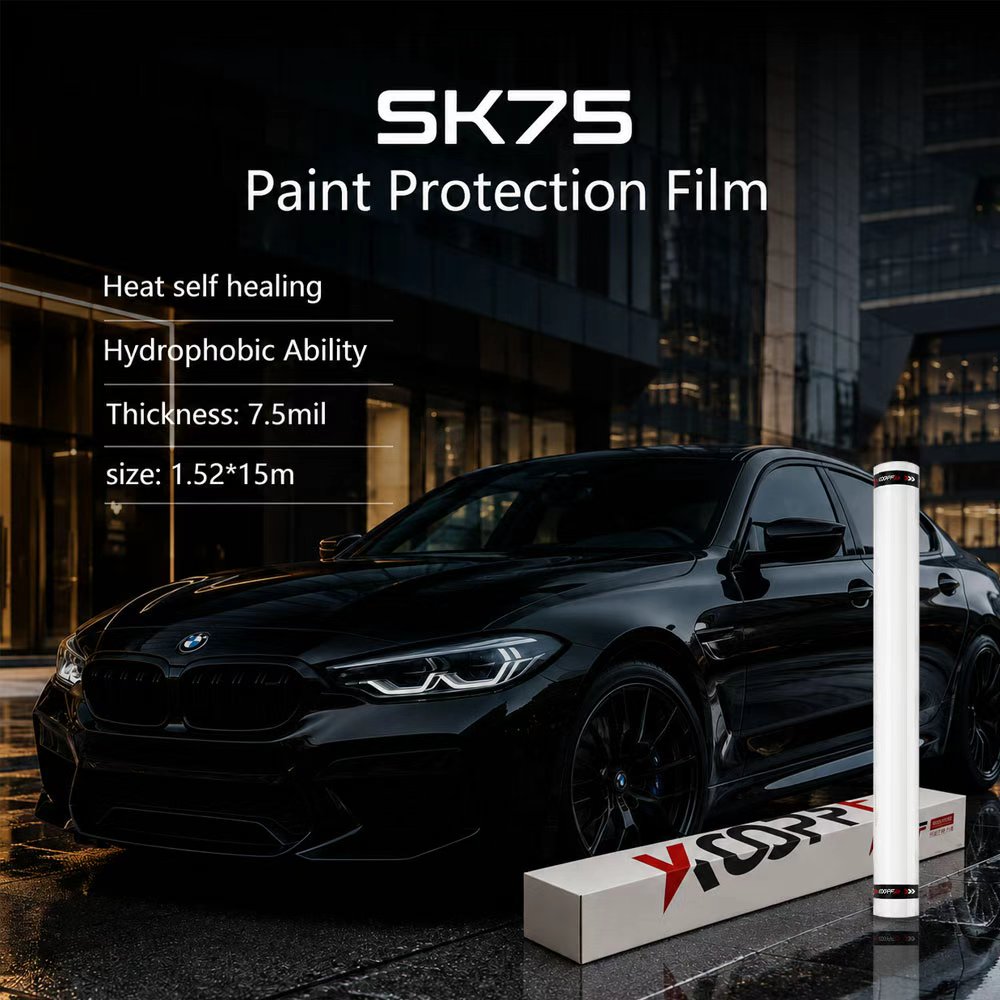
Physical inspection
Roll arrives with clearly labeled batch ID and roll serial number visible inside the core
Liner is consistent in thickness, with no visible tears, wrinkles, or adhesion anomalies along the length
Core is rigid enough to withstand standard shipping without deformation (flex the core — it should not compress under hand pressure)
No visible haze, cloudiness, or micro-bubbles in the film when held up to a light source
Bench tests
Scratch-and-heal test performed at both room temperature and heat activation: light surface scratches disappear fully within the stated healing window
Adhesion test on a flat painted panel: film lays down cleanly with no silvering or air entrapment after application
Stain resistance test: brake fluid, insect acid, and coffee left on the surface for 24 hours — clean removal with no visible staining
UV chamber or accelerated weathering test conducted (or third-party test report requested for a minimum 1,000-hour equivalent)
Installer-driven evaluation
Film tested on a complex curved panel (A-pillar, bumper corner) by an experienced installer
Stretch behavior assessed: film should elongate without whitening or stress marks on tight curves
Repositioning window timed: adequate time to correct placement without adhesive failure
Edge behavior checked: no lifting, flagging, or adhesive bleed at trimmed edges within 72 hours
Consistency across rolls
Minimum two rolls from different production batches tested — not two samples from the same roll
Gloss level, orange-peel texture, and tack feel are consistent between the two rolls
Film thickness measured at multiple points per roll — variation should be within ±0.1 mil of stated specification
Pro Tip: A supplier confident in their batch consistency will rarely resist sending samples from multiple lots. Hesitation here is diagnostic.
Stage 3: Trial Order
A trial order is not a small bulk order. It's a controlled test of the entire supply chain: production quality match, packaging integrity, documentation completeness, and logistics reliability — all in one shipment.
Order setup
Trial order placed for 20–50 rolls across the SKUs you plan to stock (not a single SKU)
Written order confirmation includes: exact SKU codes, roll dimensions, finish type, batch control requirement, and OEM packaging specifications if applicable
Payment terms and defect replacement policy agreed and documented before transfer
OEM and private-label verification
Box design, inner bag, label artwork, and carton specifications approved via a physical proto sample before mass production
Brand logo placement and liner branding confirmed on a production-run sample, not a printed mock-up
Confirmed that OEM packaging is applied in-factory, not added post-production by a packaging vendor
The supplier'sOEM/ODM PPF capabilities — including custom branding, private-label roll packaging, and product attribute customization — have been confirmed in writing
Receiving inspection
Each roll checked against the purchase order: SKU, width, length, batch ID, and labeling match
Packaging condition inspected: no crushed cores, moisture intrusion, or liner damage from transit
Sample rolls pulled from the shipment and compared to the approved sample for tack, gloss, healing behavior, and thickness — document any deviation in writing
Photos taken of any anomalies before unpacking is complete (required for claim documentation)
Lead time and logistics performance
Actual production lead time compared to quoted lead time — variation above 20% is a signal worth tracking
Shipping documentation complete and accurate (commercial invoice, packing list, certificate of origin, compliance certs for destination market)
Customs clearance process smooth — no missing documents that delayed release
Stage 4: Bulk Order Commitment
This is where most distributors relax their guard. The trial went well, the relationship feels established, and the operational pressure to reorder quickly is real. Don't skip Stage 4.
Commercial and contractual controls
Long-term supply agreement in place covering: price validity period, MOQ tiers, lead time commitments, and batch-change notification requirements
Defect replacement policy clearly defined: what percentage of a shipment qualifies for a claim, what documentation is required, and what the resolution timeline is
Batch-change notification clause included — the supplier must inform you in advance of any raw material, adhesive, or process changes that could affect film behavior
Replenishment lead times for standard SKUs are confirmed in writing (not estimated verbally)
Ongoing quality controls
Incoming inspection protocol established for all bulk shipments — not just the first one
Batch records requested for every shipment and filed for traceability
A defined escalation path exists: who to contact if a field defect is reported, and what the expected response time is
Supply continuity and scaling
Monthly production capacity confirmed sufficient to support your peak season volume without quality drift
Safety stock or buffer inventory arrangement discussed for high-velocity SKUs
MOQ flexibility confirmed for new colorways or specialty products before you list them to your channel
Key Takeaway: The most expensive sourcing mistake isn't overpaying for film. It's discovering a batch consistency problem after the film is already in your installers' hands. A robust incoming inspection protocol — applied every shipment, not just the first — is the only systematic protection against that risk.
Partnership and support infrastructure
Technical data sheets available in the language your installers and sales team use
Installation guidance, care instructions, and warranty registration materials provided in usable formats
Access to a dedicated contact for technical questions — not a general inbox with multi-day response times
For distributors building a regional presence, access to aglobal PPF distribution networkwith regional support infrastructure can reduce the overhead of managing time zone gaps and documentation for customs-compliance markets.
How to Run This PPF Sourcing Checklist
Print it. Assign a clear owner for each stage. Do not move to the next stage until every item in the current stage is either checked or explicitly waived with a documented reason.
A waived item is not the same as a skipped item. If you cannot get batch traceability from a supplier, write down that you accepted that risk and why. Undocumented waivers become unexplained problems later.
The four-stage structure is designed to match the natural progression of a sourcing relationship: qualify the supplier before you trust their samples, test the samples before you trial, trial before you commit to bulk, and control the bulk relationship before you scale. Skipping stages compresses risk — it doesn't eliminate it.
Frequently Asked Questions
How many rolls should I request for sample evaluation? Two rolls from different production batches is the minimum. If you're evaluating a color PPF product with multiple finish variants, request one roll of each finish you plan to stock. The goal is to test consistency across batches, not just the quality of a single roll.
What certifications should I require from a PPF supplier? At a minimum: ISO 9001 for quality management, REACH compliance for EU market entry, and RoHS if you're selling into regulated electronics-adjacent markets. IATF 16949 is the automotive-grade QMS standard — it's optional but signals a higher level of process discipline. For any UV performance claim, ask for third-party test reports referencing standards likeASTM D1004 for tear resistanceor SAE J1885, not just the supplier's internal lab data.
What's a reasonable trial order volume before committing to bulk? Most experienced PPF distributors use 20–50 rolls across their planned SKU mix. This is enough to run a genuine installer test, check packaging integrity across multiple cartons, and evaluate shipping documentation without committing significant capital. The trial order size should reflect your monthly turnover rate — it should be small enough that a full replacement doesn't hurt, but large enough to represent a realistic supply scenario.
How should I handle a batch inconsistency discovered after delivery? Document it immediately: photos of the affected rolls, the batch IDs, and the specific performance deviation (gloss delta, tack difference, healing failure). Submit a written claim within the window defined in your supply agreement. If no claim window was defined, submit within 14 days of delivery. A supplier that handles your first defect claim professionally is telling you something important about how they'll handle all future ones.
What makes OEM/private-label PPF sourcing more complex than standard wholesale? Three things: artwork approval cycles (packaging artwork changes affect multiple components — box, inner bag, liner, core label), MOQ tiering (custom packaging typically carries a higher MOQ than standard stock SKUs), and production scheduling (your branded production runs need to be planned into the factory calendar). Build these lead times into your product launch schedule, not around them.
Next Steps
If you're in the early stages of evaluating a new PPF manufacturer or expanding your private-label program, the checklist above covers the structural questions. What it can't do is replace hands-on installer testing and direct supplier conversations.





