



Top 5 Best Brands in China: 2026 Buyer's Guide
Top 5 Best Color PPF Brands in China: 2026 Buyer's Guide for Choosing the Right Color PPF Supplier
China's color PPF market feels crowded. Just knowing brand names cannot promise the right Color PPF supplier. This guide ranks five top brands for 2026 and shows you how to check each one. Importers, distributors, wrap shops, and OEM buyers can make a shortlist fast. We look at film quality, color range, batch consistency, warranty scope, and supply support. The best choice depends on what matters most to you.
Key Takeaways
Pick a Color PPF supplier that fits what your business needs, like color choices, order size, and support.
The top brands for 2026 include KOOPPF for private-label programs, United Auto Film for a wide range of colors, and XPEL for brand trust.
Always check suppliers by asking for samples and written warranties before you place a large order.
Quick Answer: Top 5 Color PPF Brands for 2026
The Shortlist at a Glance
You want the answer fast, so here are the five brands this guide ranks for 2026:
KOOPPF — a full-chain manufacturer from Changzhou, Jiangsu, with 200+ colors and OEM/ODM support; a strong fit for importers and private-label programs.
United Auto Film — a broad palette of 350+ colors; a fit for buyers who want variety without premium pricing.
XPEL — global brand recognition and an authorized dealer network; a fit for shops that sell on name trust.
STEK — premium finish options and a registered warranty system; a fit for high-end installation channels.
ALUKO — a wide TPU color film range; a fit for distributors testing multiple finishes.
How to Read This Ranking
No single brand wins for every buyer. Your priorities decide the ranking. A wrap shop that needs 350+ shades will read this list differently than an OEM buyer who needs batch consistency and private-label packaging. Volume, budget, and supply support shift the order too.
Treat each profile as a fit note, not a verdict. Check the comparison table first, then read the profile that matches your business model. That path helps you shortlist a Color PPF supplier without wasting weeks on samples that never fit.
What Is Color PPF and How Does It Compare?
Color PPF vs. Vinyl Wrap vs. Clear PPF
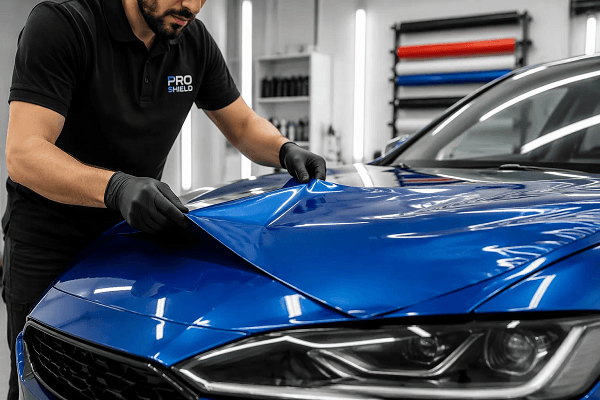
Color PPF is a thermoplastic polyurethane (TPU) film that has a color layer built in. It guards your paint and changes how the vehicle looks, all in one step. TPU is a flexible, stretchy polymer. Aliphatic TPU fights yellowing better than aromatic TPU, so top films use it. Self-healing means light scratches smooth back out when heated. A hydrophobic coating pushes away water and dirt.
The table below compares the three options on the features that drive purchase decisions.
| Attribute | Vinyl Wrap | Color PPF |
|---|---|---|
| Durability | 3 to 7 years | 7 to 10 years |
| Protection level | Minor blemishes only | Rock-chip and chemical resistance, self-healing |
| Cost tier | Lower entry cost | Higher, roughly $1,500 to $4,000 |
Vinyl works for buyers who want a cheap color change. Color PPF works for buyers who want color plus protection. Clear PPF works for buyers who want invisible defense only.
Why Buyers Choose Color PPF
Color PPF gives you customization and protection in one installation. A vinyl wrap changes color but gives limited rock-chip protection. Color PPF adds a thicker barrier against road debris, stones, and chemical etching. Many premium color films also come with a self-healing top coat and a hydrophobic layer.
This mix appeals to owners who drive on highways and face debris often. It also protects factory paint for resale. Vinyl still makes sense when the only goal is a cheap color change. Color PPF costs more, but it does two jobs at once. That dual function drives its growing demand among distributors and wrap shops.
Top 5 Color PPF Brands Compared
Comparison Table: Origin, Colors, Film Type, Warranty, MOQ
The table below lines up the five brands on the specs that shape a sourcing decision. When a brand does not publish a fixed number, the cell says the term is quote-based instead of guessing a figure.
| Brand | Origin | Color Range | Film Thickness | Warranty | MOQ | OEM/ODM Support | Best-Fit Buyer |
|---|---|---|---|---|---|---|---|
| KOOPPF | Changzhou, Jiangsu, China | 200+ colors, including metallic, color-shifting, and glow options | 7.5 and 8.0 MIL | 8 years | Quote-based | Yes, full OEM/ODM | Importers and private-label programs |
| United Auto Film | China | 350+ colors | Varies by series | Series-dependent | Quote-based | Available | Buyers wanting wide color variety |
| XPEL | Global | Curated palette | Varies by product line | Brand program terms | Dealer program terms | Limited | Shops selling on brand trust |
| STEK | Global | Premium finish options | Varies by product line | Registered warranty system | Dealer program terms | Limited | High-end installation channels |
| ALUKO | China | Broad TPU color film range | Varies by series | Series-dependent | Quote-based | Available | Distributors testing multiple finishes |
KOOPPF runs a 50,000 m² facility that puts out 80,000 rolls per month. That scale helps with bulk orders and steady batch supply.
How the Brands Differ in Positioning
The five brands fall into three tiers. XPEL and STEK sit in the premium global tier. They sell name recognition, dealer programs, and finish prestige. United Auto Film and ALUKO are in the value-focused tier. They compete on how many colors they offer and on pricing that is easy to reach. KOOPPF stands as the full-chain manufacturer. It controls TPU base film casting all the way through coating in-house, which helps with batch and color consistency.
Your business model decides which tier fits. A wrap shop that wins jobs on brand names gains from XPEL or STEK. A distributor chasing shelf variety gains from United Auto Film or ALUKO. An importer building a private label needs a Color PPF supplier with deep OEM/ODM support, and KOOPPF fits that role. None of these tiers is better by nature. Each one answers a different business priority.
Brand Profiles: Detailed Breakdown
KOOPPF, United Auto Film, and XPEL
KOOPPF is a full-chain manufacturer based in Changzhou, Jiangsu. It handles TPU base film casting and precision coating in-house. This control helps keep batches and colors consistent through its own color management system. The color line includes grey, green, yellow, blue, red, pink, black, and white series, plus metallic, color-shifting, and glow options. Most series come with a 10-year warranty; the aliphatic TPU high-gloss version has 8 years. MOQ is 1 roll, lead time is 7–15 days, and both dry and wet application work. Same-day after-sales support and full OEM/ODM capability complete the offer. The brand has 1,000+ global partners and exhibits at FESPA 2026 and Automechanika. Its weakness is positioning: it competes on manufacturing depth, not consumer brand fame. Best fit: importers and private-label programs.
| Attribute | KOOPPF Color PPF |
|---|---|
| Construction | TPU with nano self-healing coating |
| Roll size | 1.52m × 15m |
| Thickness | 7.5 and 8.0 mil |
| Warranty | 10 years (8 years on aliphatic variant) |
| MOQ | 1 roll |
United Auto Film offers 350+ colors across seven finishes, including gloss, satin, matte, metallic, crystal, liquid metal, and carbon fiber. The film uses 7.5 mil TPU with self-healing, UV protection, and hydrophobic properties. Warranty terms depend on the product. Its weakness is thinner documentation on origin and MOQ. Best fit: daily-driver shops that want variety at easy-to-reach pricing.
XPEL brings global brand recognition and an authorized dealer network. Its weakness is program structure: dealer terms control MOQ and OEM flexibility. Best fit: shops that win jobs on name trust.
STEK and ALUKO
STEK focuses on premium finish options backed by a registered warranty system. Dealer program terms set MOQ. Its weakness is price tier and limited private-label room. Best fit: high-end installation channels.
ALUKO builds TPU color film around vehicle transformation. Selected listings publish roughly 7.5 mil thickness, 98.5% UV resistance, and heat-activated self-healing, with metallic, satin, chrome-inspired, and color-shifting finishes. Expected durability runs about 5–7 years on selected products. Its weakness is SKU-level variation, so check the exact product. Best fit: custom shops chasing bold effects.
What Makes a Good Color PPF?
Film Construction and Color Consistency
Film quality starts with the base layer. PCL TPU is a material made to be flexible, tough, and resistant to aging and hydrolysis. A strong build puts the color effect between TPU layers, not on top of them. A multi-layer system typically includes a hydrophilic top coating, aliphatic TPU films, and a pressure-sensitive acrylic adhesive. The adhesive matters as much as the film. A good adhesive holds color for a possible lifespan of 10 to 12 years, resists plasticizer migration, and allows repositioning during installation before it sets.
| Property | Value | Method |
|---|---|---|
| TPU + HC thickness | 145–195 μm | GB/T 7125 |
| Gloss at 60° | ≥90 | GB 8807 |
| Initial adhesion | ≥8.5 N/25 mm | FTM 9 |
| Water contact angle | ≥105° | DL/T 864 Appendix A |
Batch-to-batch color consistency separates reliable suppliers from risky ones. An approved master sample should serve as the reference. You measure new batches with a spectrophotometer, check gloss with a gloss meter, and confirm finish under standardized lighting. Compare roll-to-roll, within-roll, and batch-to-batch. Never approve a shipment from one roll sample alone.
Warranty, Testing, and Color Options
Read the warranty scope closely. Confirm in writing what the document covers and what it excludes. Ask for QUV test hours and ΔE values. ΔE00 (CIEDE2000) is a common method for small color differences, and no single ΔE limit fits every color PPF. Agree on tolerances before mass production. Also confirm the color range you need, including metallic and color-shifting finishes.
Installer skill often matters more than brand at the premium tier. A skilled installer gets clean edges and a smooth finish from most quality films. A poor installation can ruin a good roll. Vet your installer as carefully as your supplier.
Pros and Cons of Color PPF
Advantages for Buyers and End Users
Color PPF gives you a full color change and real impact protection in one product. Vinyl wraps give color but no protection, and clear PPF gives protection but no color. Color PPF gives you both at the same time. The film also blocks 99% of UV rays, which slows oxidation and fading of the factory paint underneath.
The benefits go beyond the installation itself:
Reversible: The film comes off cleanly without harming factory paint, so you can change colors again or go back to the original finish. This works especially well for leased vehicles.
Self-healing: Light scratches and swirl marks from car washes go away when exposed to normal heat. Minor surface scratches heal on their own above 140°F (60°C), with no polishing needed.
Resale value: The factory finish stays intact under the layer, and professional installs include records you can share with future buyers.
Durability: Good colored PPF usually lasts 5–10 years with proper care.
Limitations to Plan For
Budget is the first limit. A full-car color PPF job runs about $4,000–$8,000+, compared with $2,000–$4,000 for vinyl. The TPU material costs more than PVC, and the install is more complex.
Installation takes skill. Colored PPF is stiffer and harder to stretch than clear film, so installers often use warm water. Flaws show up more clearly on a colored surface. DIY is still possible but hard, and beginners may waste material. Color choice also falls short of vinyl. The range covers gloss, matte, metallic, satin, and specialty effects, but it is not as unlimited as colored vinyl.
How to Choose the Right Color PPF Supplier
Verifying a Color PPF Supplier
Checking a supplier starts with paperwork, not price lists. Proof falls into three kinds: company certificates, finished-product test reports, and material-supplier documents. A certificate picture by itself proves very little. Look at who issued it, the product named, what it covers, and the dates. An ISO 9001 certificate covers a management system, not how the film performs. A finished-product report must name the tested model, the method, the conditions, and the results. Make sure the film you get matches that report.
Next, get the warranty scope in writing. Ask what the policy covers, what it leaves out, and who handles a claim. Clarify exclusions tied to storage, installation, maintenance, climate, and paint condition. Also confirm the remedy: replacement, credit, or repair support.
Then check factory scale and repeat supply capacity before you build a distributor program. Ask for batch samples and tie each one to a model, batch, and dated spec. Test stretch, adhesive feel, hydrophobic behavior, and self-healing response. Keep roll IDs with your test results. Ask the supplier to tell you about material or construction changes before repeat orders.
The Sourcing Process from Sample to Shipment
A structured path protects your money. Follow a clear sequence:
Write a product brief covering finish, roll size, packaging, volume, and destination market.
Shortlist suppliers whose range and service level match the project.
Request technical data sheets, test reports, warranty terms, and OEM details.
Order samples from the exact grade being quoted.
Run controlled installation tests with experienced installers.
Verify the factory through an on-site visit, video audit, or third-party inspection.
Place a trial order before committing to a large program.
Inspect rolls, labels, packaging, and batch documents before shipment.
Track field performance by batch, then scale gradually.
A trial of 10–50 rolls and a sample budget of $200–$500 including express shipping is recommended. Standard wholesale orders for Color PPF start from 20 rolls, while OEM packaging and private-label orders start from 100 rolls.
Supply support decides long-term value. Confirm lead-time milestones and a delay recovery process. Test technical support responsiveness with a real question during sampling. Check OEM/ODM flexibility early if you plan a private label. A reliable Color PPF supplier answers claims fast and documents every change. Choose a Color PPF supplier that treats your trial order with the same care as a container load.
Common Sourcing Mistakes and 2026 Trends
Mistakes That Cost Buyers Money
Buying on price alone is the top mistake. Comparing prices across different tiers means nothing. A car owner mostly pays for labor, while a distributor mostly pays for materials. The same spec can cost $400 factory-direct and $1,500+ from a domestic distributor. Know your tier before you negotiate.
Skipping batch samples is the second costly error. One roll proves nothing about the next container. Order a sample roll first; this runs about $350 to $420 including air freight. Third, buyers ignore warranty exclusions. Read what the policy leaves out before you sign. Fourth, many buyers accept verbal after-sales promises. Get claim handling, remedies, and response times in writing. Align every quote on the same TPU brand, thickness, warranty, and coverage map before you compare numbers.
Trends Shaping Color PPF in 2026
Color-shifting and metallic finishes keep gaining ground. Matte, satin, and color-shifting films now drive look-based customization, and the global PPF market is expected to grow at a CAGR of over 7% from 2024 to 2030. Expect more finish options from every Color PPF supplier.
OEM/ODM demand is rising too. Distributors want private-label packaging and custom shades, and full-chain manufacturers now advertise that ability openly. KOOPPF, for example, casts its own TPU base film and coats in-house. Buyer scrutiny is the third shift. Buyers now ask for proof of performance before they invest. Expect requests for QUV data and ΔE values; KOOPPF publishes figures showing premium films last at least 3,000 QUV hours before serious discoloration. Choose a Color PPF supplier that documents batch consistency and answers these questions fast.
Pick the brand that fits what matters most to you: color range, volume, budget, and support. Premium global brands work well for shops that sell on name trust. Brands with many color choices work for buyers who want lots of options. Full-chain makers like KOOPPF work for private-label programs.
Next, ask for samples. Go through the supplier checklist. Then place a small trial order and make sure your Color PPF supplier sends batches that stay the same.
FAQ
Which color PPF brand suits a first-time importer?
Start with a full-chain manufacturer that supports small orders. KOOPPF accepts a 1-roll MOQ, ships in 7–15 days, and offers same-day after-sales support. That combination lowers your trial risk.
How many colors should you expect from a color PPF supplier?
Ranges vary widely by brand. KOOPPF offers 200+ shades, including metallic, color-shifting, and glow options. United Auto Film lists 350+ colors. Confirm the exact finish you need before you commit.
What warranty terms should you confirm in writing?
Ask what the policy covers, what it excludes, and who handles claims. Confirm the remedy, whether replacement, credit, or repair support. KOOPPF backs most color series with a 10-year warranty.





